
If the life of Subhrajit Bhattacharjee were to be captured in a single word, that word would perhaps be exploration. At times through words, at times under the lights of the stage, sometimes through the lens of a camera, and at other times through the timeless works of Rabindranath Tagore, he has continued to explore people, society, culture and the spirit of an era.
A journalist, anchor, recitation artist and Tagore researcher, Subhrajit Bhattacharjee has, through these many identities, evolved into a distinctive cultural personality.
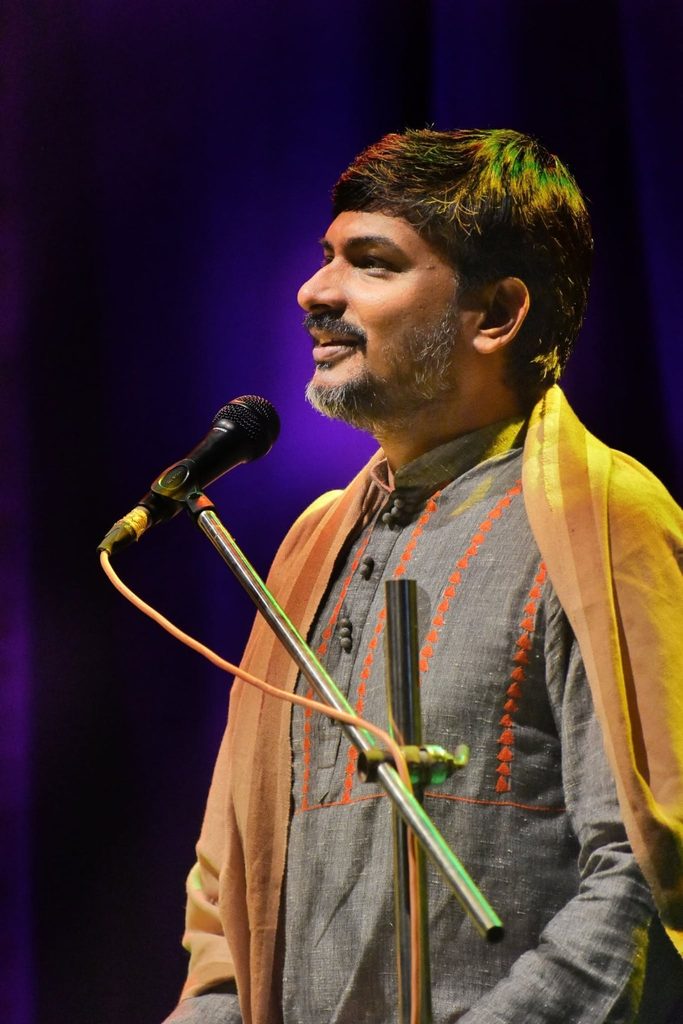
Born on November 2, 1981, Subhrajit’s childhood was spent in the lanes of Jogendranagar, surrounded by familiar neighbours and a financially modest family environment. His father, Sujit Kumar Bhattacharjee, worked at the office of the District Magistrate of West Tripura, while his mother is Shibani Bhattacharjee and his brother Sunandit Bhattacharjee.
Alongside the values he inherited from his family, his personality was profoundly shaped by an education rooted in the ideals of Ramakrishna and Swami Vivekananda.
His early education began at Anandamarga School in College Tilla. From Class III through Class X, he studied at Ramakrishna Mission School, Vivekananda Nagar. It was here that the ideals of Sri Ramakrishna, Holy Mother Sri Sarada Devi and Swami Vivekananda became deeply intertwined with his formative years.
For Subhrajit, the Ramakrishna Mission was not merely a place for academic learning. Knowledge, discipline, humanity, self-reliance and the spirit of service became integral parts of his education and gradually shaped his outlook towards life.
The values he absorbed during those formative years continued to influence his journey in many ways. Swami Vivekananda’s teaching of recognising strength and potential in every human being, Sri Ramakrishna’s message of harmony among religions, and the idea of service as an important purpose of life enriched his intellectual and cultural outlook.
For him, therefore, culture is not merely a form of entertainment; it is also a powerful medium of reaching people.
The next chapter of his educational journey was equally significant. After completing his Higher Secondary education from Hindi Higher Secondary School in 2000, he moved to Ramakrishna Mission Vidyamandira at Belur Math, where he graduated in 2003 with Honours in English.
The spiritual and cultural environment of Belur Math left a deep impression on his mind, traces of which can be found throughout the various stages of his later life. He subsequently completed his postgraduate studies in Mass Communication from Rabindra Bharati University.
It was as though two streams—Ramakrishna-Vivekananda’s philosophy of humanity and Tagore’s vision of universal humanism—came together to shape his distinctive cultural identity. But Subhrajit’s story is not simply a story of academic degrees.
His association with public speaking, debates and recitation competitions began during his school years. After entering Class XI, he developed a special fascination for stage anchoring. What began with small events such as children’s programmes gradually took him to important stages across the country and abroad.
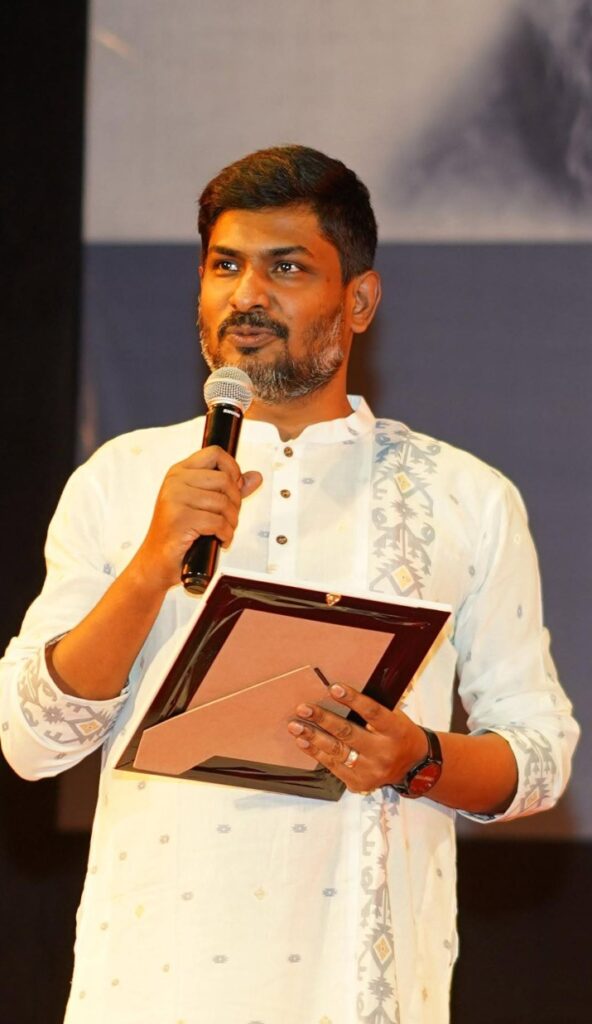
For Subhrajit, the stage is not merely a place to speak. It is a living space for establishing a connection with people. How words should reach an audience, when to pause, and when silence itself can become a form of expression—years of experience have given him a distinctive command over this art.
He has had the opportunity to anchor hundreds of programmes at international, national and state levels. From West Bengal to Uttar Pradesh, Rajasthan to Nagaland, Manipur, Assam and Delhi, his anchoring assignments have taken him to different parts of the country. He has also had the opportunity to work at programmes organised by several reputed institutions, including the Sangeet Natak Akademi, apart from being associated with numerous cultural and social organisations over the years. His journey in journalism also began during his university years, and it continues to this day.
Working closely with electronic media, Subhrajit has observed news, people and society from a close distance. Conducting interviews has been one of the notable aspects of his journalistic career. Among his professional achievements is the experience of interviewing three Nobel laureates. His experience of anchoring programmes on several international platforms has also added a distinctive dimension to his professional journey.
Another important chapter of his creative life is his work as an author.
He has already published three books. One of them, Tarader Mukhomukhi (Face to Face with the Stars), features interviews with renowned and popular personalities from India and abroad.
His poetry collection, Amar Ayushkal Tomake Dilam (I Give You My Lifetime), is a bouquet of blooming roses of love for adolescents, young men and women. His inclination to capture the stories behind people’s lives, experiences and achievements in words is yet another expression of his journalistic sensibility.
Yet, among his many identities, the one that perhaps occupies the deepest place in his heart is that of a Tagore researcher and seeker.
His love for Rabindranath Tagore is not merely the affection of a reader. It has developed into a long journey of research, collection, exploration and creative presentation.
Every year, around Tagore’s birth anniversary, Subhrajit has been working as the principal creative force behind exhibitions dedicated to the poet. So far, three such exhibitions have been organised outside Tripura and in Bangladesh.
His objective appears to be not merely to present Tagore as a subject of academic study, but to introduce the poet’s ideas to a new generation as a living intellectual and cultural world deeply connected with human life, society and the times.
The deep connection between the humanistic vision of Ramakrishna and Vivekananda and Tagore’s philosophy of universal humanism finds a distinctive reflection in Subhrajit’s cultural journey.
His respect for humanity, his quest for knowledge and his urge to bring culture closer to people have deep roots in the values he absorbed during his childhood and formative years.
Photography is another of Subhrajit’s passions.
Through the camera’s eye, he searches for the stories hidden within fleeting moments. Whether it is a stage, a person, nature or a cultural setting, he observes everything with an inquisitive eye.
For him, photographs are another language through which memories and moments can be preserved—alongside words.
At the beginning of his professional career, Subhrajit served as the Centre Head of NIS Academy. Since 2010, he has been associated with the Tripura State AIDS Control Society. As part of his professional responsibilities, he also had the opportunity to work for nearly one and a half years at the office of the National AIDS Control Organisation (NACO) under the Union Ministry of Health and Family Welfare.
In 2024, he returned and rejoined the Tripura State AIDS Control Society.
Recognition for his work in anchoring, journalism and cultural activities has also come from various quarters over the years. Several organisations have honoured him for his contributions.
Yet, Subhrajit Bhattacharya cannot be fully understood through a list of awards and honours.
To understand him, one needs to look at the person who brings words to life while standing on a stage, reads the pulse of time through the eyes of a journalist, captures fleeting moments through a camera, and rediscovers Tagore year after year on the poet’s birth anniversary.
The seeds planted during childhood through the ideals of Ramakrishna and Vivekananda were nurtured throughout his education and subsequently found a wider social expression through journalism and anchoring.
His years at Rabindra Bharati University and his growing engagement with Tagore studies gave this journey an even deeper cultural direction.
In Tripura’s cultural landscape, therefore, Subhrajit Bhattacharjee is more than a journalist, anchor or Tagore researcher.
He represents an ongoing cultural journey—a journey in which the spiritual ambience of Belur Math, Swami Vivekananda’s human-centred philosophy, Rabindranath Tagore’s dream of universal humanity, the lights of the stage, the bustle of the newsroom, the frame of a camera and the rhythm of recitation have converged into a single stream.
And that stream has not yet come to a halt.
Every new stage, every new interview, every new photograph and every new exploration of Tagore continues to take him towards a more distant and luminous horizon.
A horizon where knowledge is not merely something to be acquired, culture is not merely something to be enjoyed, and the stage is not merely a place to stand beneath the lights.
Instead, the search for humanity in all these forms becomes the greatest pursuit of life.