
Agartala, 5th May 2026: For the first three days of May, the skies of Guwahati seemed to resonate with an invisible melody — at times the gentle strains of Rabindra Sangeet, at others the timeless presence of a poet deeply etched into collective memory. The three-day exhibition celebrating the birth anniversary of Gurudev Rabindranath Tagore, held at the art gallery of the ITA Pragjyoti Cultural Centre, was far more than a cultural event. It emerged as a thoughtfully curated cultural reconstruction where history, emotion, and aesthetics blended with remarkable finesse.
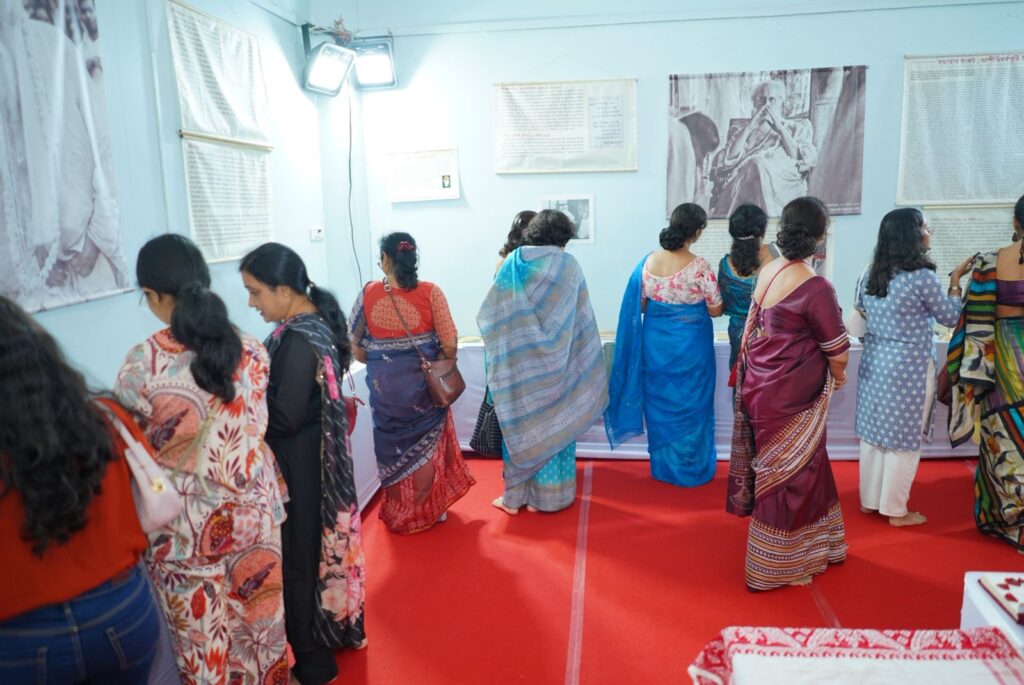
Organised by Assam-based cultural organisation Shobdoghor from May 1 to 3, the exhibition reflected a clear vision at every level — not merely to commemorate Rabindranath Tagore, but to rediscover and reinterpret him for contemporary audiences. From the very moment visitors entered the gallery, it became evident that the exhibition was not simply a display of photographs or archival information. Instead, it unfolded as a carefully structured narrative focusing on a unique chapter of the poet’s life — the history of celebrating his birthdays across different phases of his life.
The exhibition was designed like a long journey through time. It began with the story of Tagore’s first birthday celebration — an intimate and emotional beginning. The narrative portrayed the young poet stepping from the age of 26 into 27, experiencing a formal birthday celebration for the first time, lovingly arranged by members of his family. Initiated under the guidance of Jnanadanandini Devi and vividly described in the emotional recollections of Sarala Devi Chaudhurani, the scenes came alive on the exhibition walls — flower garlands, morning prayers, and the quiet beginning of a new tradition.
Interwoven within this narrative was a deep sense of sorrow — the passing of Kadambari Devi, after which the significance of celebrating Tagore’s birthday seemed to acquire a more profound emotional meaning. Rather than avoiding this painful chapter, the exhibition embraced it with sensitivity, allowing visitors not only to learn history but to feel its emotional depth.
As visitors moved further, the exhibition gradually revealed the final phase of the poet’s life — his 81st birthday celebration. Here the atmosphere shifted entirely. The serene ambience of Santiniketan, the morning Baitalik, the quietness of the ashram, and the contemplative presence of an ageing poet were recreated with remarkable detail. Floral decorations surrounding sandalwood-adorned portraits, offerings of kheer payesh, incense, and the fragrance of sandalwood together created an intensely spiritual atmosphere. References to Tagore’s famous address Crisis in Civilization, the devotional setting, and accompanying music transformed this section into the emotional climax of the entire exhibition.
The exhibition’s greatest strength lay in its presentation. History was not confined to the pages of books; rather, it was transformed into a living experience through the harmonious use of visuals, sound, and language. Every book, photograph, written account, and arrangement reflected meticulous planning and deep scholarly engagement, clearly demonstrating the extensive preparation behind the initiative.
On the inauguration day, noted Rabindra Sangeet exponent Manoj Murali Nair toured the exhibition and remarked that he had never before witnessed such a cohesive and intellectually rich presentation. According to him, an exhibition of this nature could only emerge through immense dedication, devotion, and artistic sensitivity.
At the heart of this entire initiative was the vision and tireless effort of Subhrajit Bhattacharjee, whose contribution transformed the exhibition into a deeply immersive cultural experience. His work went beyond collecting historical information; it was an art of bringing history alive. Bhattacharjee presented historical research as compelling storytelling while grounding every narrative in authenticity and documentation. His work demonstrated that research need not remain confined to the silent corners of libraries — when presented thoughtfully, it can become a powerful force capable of stirring public consciousness.
Organised under the initiative of Guwahati-based recitation and cultural organisation Shobdoghor and its chief director Parmita Nag, the exhibition emerged as a quiet cultural revolution where scholarship, art, and emotion were woven together seamlessly. Bhattacharjee’s unwavering dedication illustrated how the commitment of a single individual can inspire the beginning of a much larger cultural movement.
Even after the curtains fell on the final day, the emotional resonance of the exhibition lingered in the minds of visitors. For this three-day event ultimately posed a deeper question — how deeply are we willing to carry culture within ourselves? The exhibition offered one possible answer: that history is never merely the past, but something that continues to live within the present.
Guwahati’s celebration of Rabindranath Tagore’s birth anniversary was therefore not just an exhibition; it was an experience, a realization, and a bridge of memory — built with devotion, creativity, and profound love for the poet and his legacy.